· Design & Ambiance · 7 min read
Restaurant Ceiling Design: Height, Materials, and Acoustic Impact
The ceiling is the largest uninterrupted surface in your restaurant — here's how to use it to control noise, shape atmosphere, and define your concept.
Most restaurant owners spend serious money on floors, furniture, and wall treatments, then treat the ceiling as an afterthought. That’s a costly mistake. According to Rockfon’s analysis of restaurant ceiling design, the ceiling is typically the largest single surface in any dining room — and it’s the single most effective location for acoustic treatment, because sound naturally rises. Get the ceiling wrong and your restaurant will be painfully loud, poorly defined in concept, or both.
This guide covers the design and functional dimensions of ceiling decisions, from height and material selection to acoustic performance and the role of suspended elements.
Why Ceiling Height Matters More Than You Think
Ceiling height is one of the most powerful tools in shaping how a space feels. It’s not just about square footage — it determines the emotional register of the entire room.
Higher ceilings, generally above 12 feet, create a sense of grandeur, formality, and occasion. They work well for fine dining and special-occasion restaurants where guests expect to feel like the space is built to impress, as explored in restaurant design psychology. The downside is that high-ceilinged rooms are acoustically challenging — sound has more space to build, and without aggressive acoustic treatment, reverberation can become overwhelming once the room fills.
Lower ceilings in the 8 to 10 foot range feel intimate and cozy. Neighborhood bistros, wine bars, and casual dining concepts often work best in this range. The trade-off is that they can feel claustrophobic if the dining room is small, and they limit the ceiling treatments you can layer in — there’s less visual room to work with.
The practical insight: don’t chase ceiling height as a proxy for quality. The question is whether the ceiling height reinforces your concept. A ramen shop with 18-foot ceilings feels dissonant. A steakhouse with 8-foot drop ceilings feels cramped and off-brand. Match height to concept, then solve for acoustics accordingly.
The Ceiling as an Acoustic Workhorse
The fundamental acoustic rule is that sound absorbs best where it’s treated first, and in most dining rooms that means the ceiling. Rockfon’s restaurant ceiling research confirms that the right mix of sound diffusion and absorption is critical for patron comfort during conversation.
What does that mean in practice?
Reverberation time is the key metric. In most restaurant dining rooms, a reverberation time of 0.6 to 1.0 seconds is the target for comfortable conversation. Below 0.6 seconds and the room sounds dead and flat. Above 1.0 seconds and conversation becomes effortful — guests raise their voices, servers mishear orders, and the ambient noise level spirals upward as everyone compensates.
Acoustic ceiling tiles are the most straightforward solution. Modern acoustic tiles bear no resemblance to the institutional drop-ceiling grids of the 1980s. They’re available in hundreds of textures, colors, finishes, and custom shapes that integrate naturally into any design concept. Noise Reduction Coefficient ratings tell you how much sound a material absorbs — look for NRC ratings above 0.70 for meaningful acoustic performance.
Suspended acoustic baffles and cloud panels hang perpendicular to or parallel with the ceiling plane, complementing other acoustic treatment strategies, floating as design elements in their own right. These are particularly effective in spaces with exposed structure where you can’t treat the primary ceiling directly. Baffles work by increasing the total absorptive surface area without requiring wall-to-wall coverage.
The design challenge is integrating these functional elements so they appear intentional rather than retrofitted. The best restaurant ceilings solve acoustics through the design rather than in spite of it.
Ceiling Treatment Styles and Concepts
Exposed Industrial Ceilings
The exposed industrial aesthetic — visible ductwork, pipes, structural beams, conduit, and sprinkler systems — became mainstream over the past decade and shows no sign of retreat. When done well, it creates an honest, urban character that resonates with casual, fast-casual, and brewery concepts.
The acoustic liability of exposed industrial ceilings is severe. Concrete deck and metal ductwork are hard, reflective surfaces that bounce sound efficiently. An exposed ceiling with no acoustic treatment is essentially a reverb chamber. Operators who love the industrial look but need noise control have two practical options: suspended acoustic panels hung below the structure (baffle systems), or acoustic spray applied directly to the concrete deck. The spray treatment is invisible from below when well-executed and can reduce noise significantly without compromising the aesthetic.
Wooden Ceilings
Exposed wood beams, paneled ceilings, and timber plank installations bring warmth and texture that read well across a range of concepts — from rustic farmhouse to refined Scandinavian modern. As Rockfon notes, wood ceilings create warmth through exposed beams or intricate paneling suited to both rustic and contemporary settings.
Wood is acoustically semi-absorbent at low frequencies but reflective at high frequencies, making it a partial solution at best. Wood beam ceilings typically need acoustic treatment between beams — fabric panels, acoustic fill, or supplemental baffles — to achieve good performance.
Coffered and Tray Ceilings
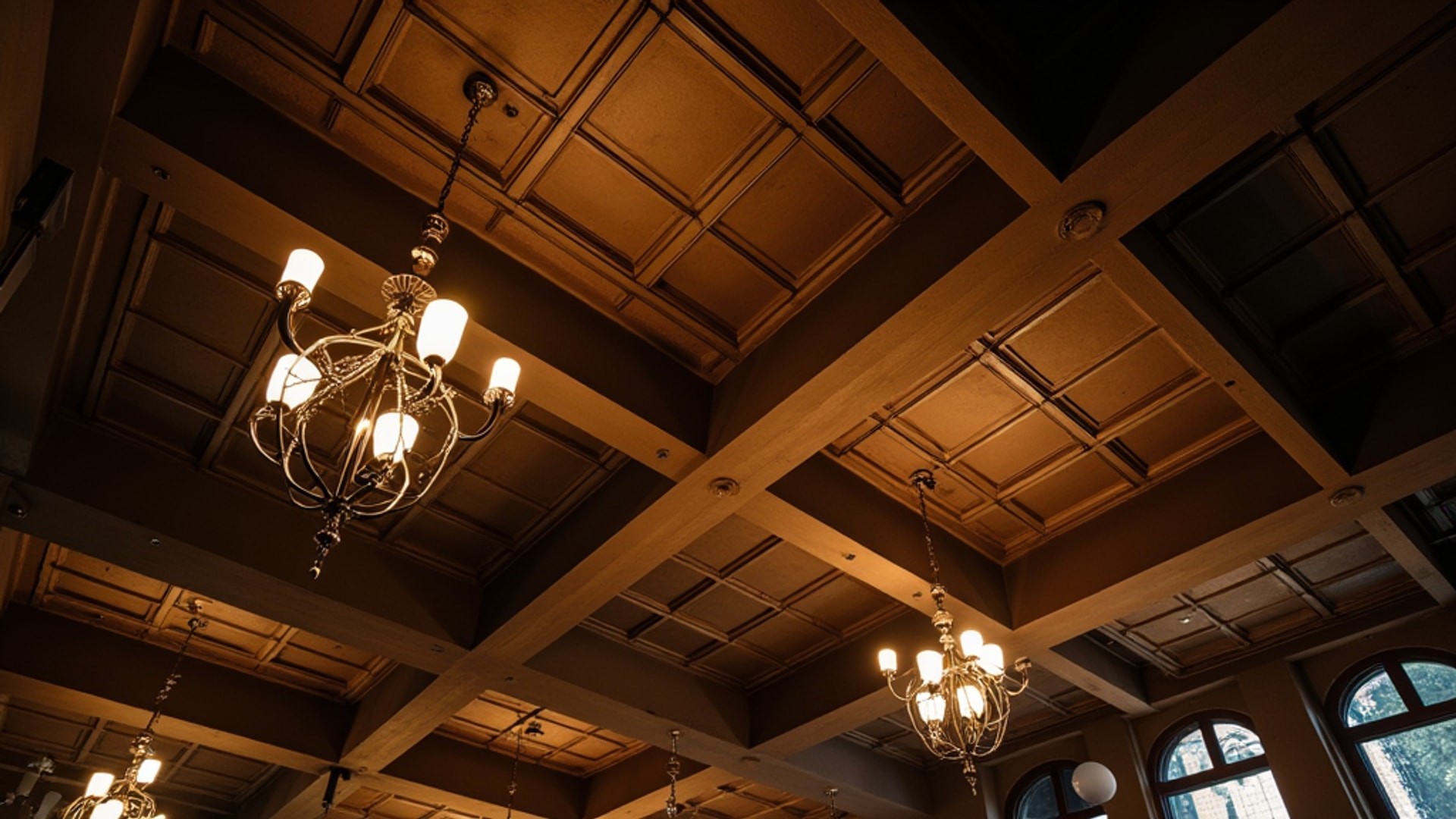
Coffered ceilings, which divide the ceiling plane into recessed geometric panels, and tray ceilings with multiple inset levels are classic techniques that add architectural depth and formality. They’re well-suited to fine dining and upscale casual concepts. The recessed geometry itself provides a degree of sound diffusion, breaking up flat reflections, but dedicated acoustic material in the coffers is still required for meaningful noise control.
Vaulted and Domed Ceilings
Vaulted and domed structures create impressions of grandeur and are suited to historically notable buildings or high-concept restaurants built around architectural drama. They’re acoustically demanding — curved surfaces focus sound rather than diffuse it, creating “whispering gallery” effects or hot spots where noise concentrates. If your space has a vault or dome, work with an acoustical engineer early. The treatment strategy is different from flat or low-slope ceilings.
Acoustic Tiles in Decorative Systems
The best modern approach is to design the acoustic solution as the ceiling feature itself. Perforated metal ceiling panels with acoustic backing, felt tile systems in geometric patterns, and custom-fabricated cloud installations can all deliver high acoustic performance while functioning as distinctive design elements. This approach eliminates the compromise between looks and function.
Suspended Ceiling Elements
Beyond the ceiling plane itself, the space between the ceiling and guests is design real estate. Hanging gardens, pendant light clusters, fabric installations, art mobiles, and custom sculptural work all draw the eye upward and create visual depth in the room. Rockfon specifically identifies suspended decorative elements like hanging gardens or art installations as tools for creating visual focal points.
From an acoustic standpoint, suspended elements provide a bonus: they interrupt the direct path of sound reflections between ceiling and floor, adding a degree of diffusion and absorption depending on the material. Fabric installations are particularly effective — dense woven fabric absorbs sound while hanging in three-dimensional space.
Projection Mapping: The High-Tech Option
For restaurants built around experience and storytelling, projection mapping on ceiling surfaces can create dynamic, programmable visual environments that shift throughout service. Rockfon notes this capability specifically for false ceilings and themed dining concepts. The technical requirements are substantial — properly positioned projectors, a smooth receiving surface, and calibrated content — and the cost is significant, but for the right concept, it creates a ceiling that actively earns its keep as a revenue-generating element.
Practical Decisions: What to Specify When
When you’re working through ceiling decisions with your designer, the key questions are:
What is my target acoustic performance? Define a reverberation time goal before selecting materials. This determines how much absorptive area the ceiling must provide.
What does my concept require visually? Industrial loft, rustic warmth, modern minimal, or theatrical drama each point toward different treatments.
How tall is the space and can I modify it? In leased spaces, you often can’t alter existing structure. Know your constraints before designing.
What is my maintenance tolerance? Fabric and acoustic tile systems require periodic cleaning or replacement. Plaster and concrete finishes are lower maintenance but harder to modify acoustically after the fact.
What are the code requirements? Fire-rated ceiling assemblies are required in many commercial occupancies. Verify requirements with your architect before specifying any materials.
The ceiling is doing at least three jobs simultaneously in every restaurant: defining the atmosphere, controlling acoustics, and delivering on the brand concept. Treat it as seriously as any other design decision and it will reward you with a better dining room. Treat it as an afterthought and you’ll spend years managing noise complaints and awkward aesthetics.
→ Read more: Lighting and Ambiance
→ Read more: Restaurant Art and Decor