· Design & Ambiance · 11 min read
Restaurant Accessibility and Inclusive Design: Beyond Minimum Compliance
With 61 million Americans living with disabilities and UK restaurants forfeiting an estimated 163 million pounds per month from inaccessible spaces, accessibility is both a legal obligation and a business imperative. This guide covers physical access, restroom design, communication, digital compliance, and the universal design philosophy that benefits every guest.
Accessibility is not a checkbox. It is a design philosophy that determines whether 61 million Americans — and their families, friends, and colleagues — can eat at your restaurant.
According to the ADA National Network, approximately 61 million Americans live with disabilities, making accessibility both a legal obligation under the Americans with Disabilities Act and a significant business opportunity. According to research on disability inclusion in the UK dining sector, inaccessible restaurants forfeit an estimated 163 million pounds per month in potential revenue from disabled diners and their companions. That number counts not just the individual with a disability, but the entire party that chooses a different restaurant because yours cannot accommodate everyone at the table.
And the legal exposure is real. According to SBI Contracting’s ADA compliance research, non-compliance can result in monetary penalties ranging from $55,000 to $75,000 for a first violation and up to $150,000 for subsequent offenses, plus potential lawsuits and required retrofitting at the owner’s expense.
Here is what the law requires, what good design looks like beyond the legal minimum, and why the restaurants that treat accessibility as a hospitality priority serve more guests and face fewer lawsuits.
Physical Access: From Parking Lot to Table
Accessibility starts in the parking lot and extends through every space a guest occupies during their visit.
Parking
The DOJ’s ADA Title III requirements mandate one accessible parking space for every 25 standard spaces. Standard accessible spaces must be at least 8 feet wide with a 5-foot access aisle. Van-accessible spaces must be at least 11 feet wide with a 5-foot aisle to accommodate side-loading wheelchair ramps and lifts.
WebstaurantStore’s ADA compliance guide specifies a maximum slope of approximately 2.08 percent (a ratio of 1:48) for accessible parking areas, with clear marked routes connecting parking to the building entrance.
Entrances
The primary entrance must be at least 36 inches wide to accommodate wheelchairs, per DOJ ADA requirements. Round doorknobs should be replaced with loop or lever handles. Door hardware must require no more than 8 pounds of opening force, which accommodates people with limited hand strength or mobility.
When the entrance involves a level change greater than half an inch, a ramp is required. Ramps must have a maximum slope of 1:12 (one inch of rise per 12 inches of ramp length) and a minimum width of 36 inches. Handrails on both sides are required for rises exceeding 6 inches.
TouchBistro’s accessibility guidelines make a good point: universal design principles prefer ramps integrated into the main entrance rather than relegating wheelchair access to a side door. This is not just better ethics — it is better design. A main-entrance ramp benefits everyone: guests with strollers, delivery workers with hand trucks, staff moving heavy equipment, and anyone with a temporary injury.
Dining Area
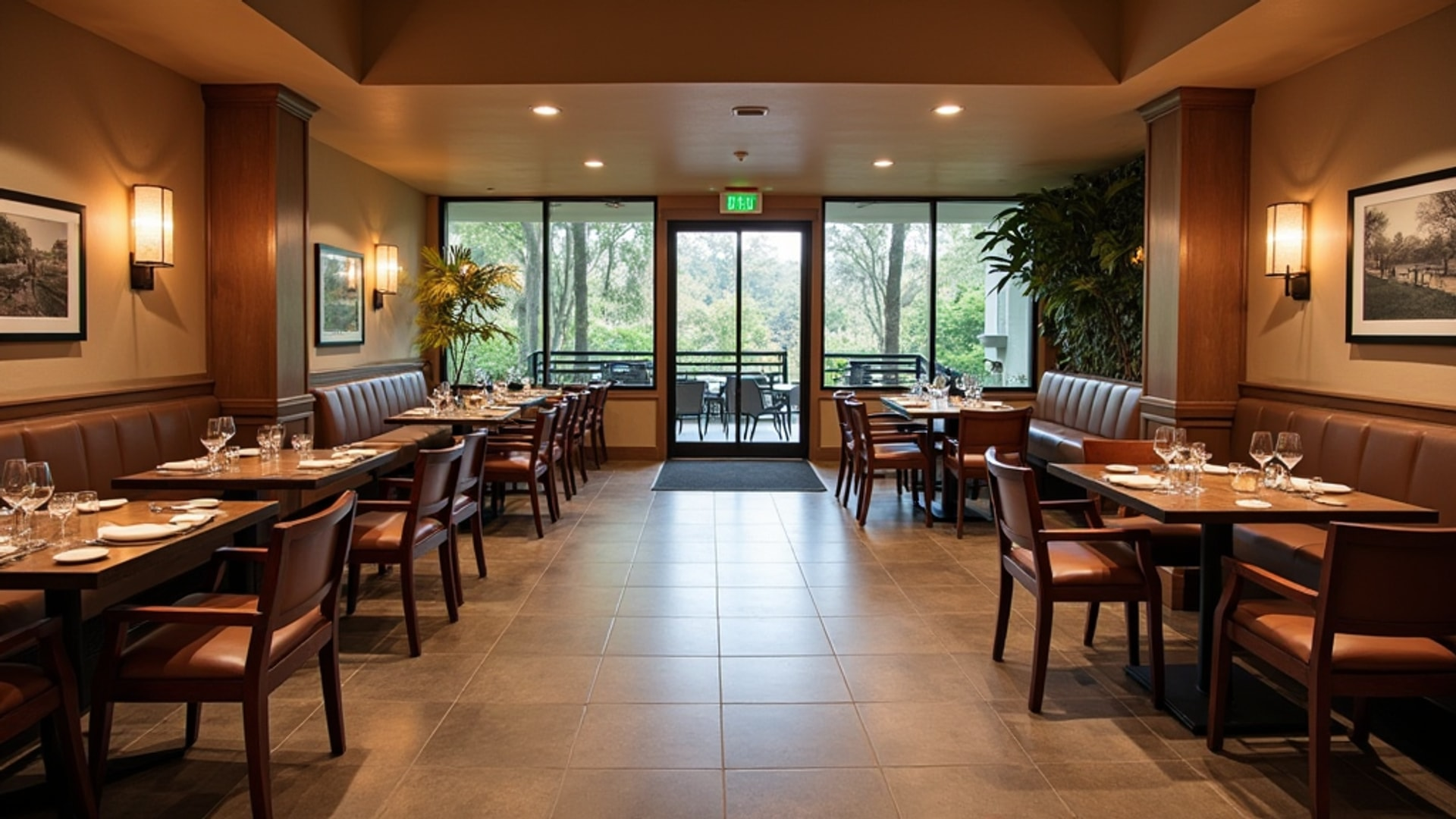
Oak Street Manufacturing’s ADA guidelines specify that at least 5 percent of all tables (or a minimum of one) must be wheelchair accessible, with heights between 28 and 34 inches. Knee clearance under accessible tables must measure at least 27 inches high, 30 inches wide, and 19 inches deep to accommodate wheelchair footrests and knee guards.
Each accessible seating position requires a 30-by-48-inch clear floor space that connects directly to an accessible route through the dining room. Aisles must be at least 36 inches wide for wheelchair passage.
Distribution, Not Segregation
This is the requirement most restaurants get wrong. Accessible tables must be dispersed throughout the facility, not clustered in a single section. A wheelchair user should have the same dining location options as every other guest — window tables, prime spots, different dining zones. Confining accessible seating to a corner near the kitchen door is technically non-compliant and practically insulting.
If a restaurant offers multiple seating types — standard tables, booths, bar seating, patio dining — accessible alternatives must exist for each type. Pedestal-style table bases generally provide better wheelchair clearance than four-legged designs because they eliminate the leg obstructions that prevent wheelchair users from pulling close to the table.
Restroom Accessibility
Restrooms are where many restaurants fail their accessibility obligations. The requirements are specific and non-negotiable.
Stall Dimensions
ADA restroom standards require accessible stalls to be at least 60 inches wide by 56 inches deep, with a 60-inch turning diameter for wheelchair maneuverability. This is the space needed for a wheelchair to enter, turn, and position alongside the toilet for a lateral transfer.
Fixtures and Hardware
SBI Contracting’s ADA restroom research specifies:
- Toilet height must be 17 to 19 inches above the finished floor, matching typical wheelchair seat heights to facilitate easier transfers.
- Toilet position must be 16 to 18 inches from side walls or partitions for transfer clearance.
- Sinks must be mounted between 29 and 34 inches from the floor with knee clearance underneath for wheelchair users.
- Faucets must be operable with one hand without tight grasping or twisting. Lever-style or sensor-activated faucets are the standard.
- Grab bars are required in at least one stall and must meet load-bearing requirements.
Doors and Clearance
Restroom doors must be at least 36 inches wide. Outward-swinging, self-closing doors are preferred. If the door swings inward, a minimum 60-by-60-inch unobstructed maneuvering clearance must be provided within the stall. Door handles and latches must be operable with one hand, mounted between 34 and 48 inches above the finished floor.
Accessories
All dispensers, dryers, and accessories must have operable parts positioned between 15 and 48 inches above the finished floor so they can be reached from a seated position. This includes soap dispensers, paper towel dispensers, hand dryers, sanitary product dispensers, and coat hooks.
Signage
Clear signage must indicate restroom locations and identify which facilities are accessible. Braille signage is required on restroom doors.
Communication and Service Access
Physical access means nothing if a guest cannot read the menu, communicate with staff, or navigate the ordering process.
Menu Accessibility
The DOJ’s ADA requirements mandate that restaurants communicate effectively with guests who have hearing, vision, or speech disabilities. Menus should be available in large print, Braille, and digital accessible formats. Digital menus accessible through smartphones serve guests who require assistive technology, and they have the added benefit of enabling real-time menu updates.
Service Animals
Service animals must be permitted in all areas where customers are normally allowed, including dining areas, patios, and indoor spaces, regardless of any no-pet policy. This is not a grey area. A service animal is not a pet, and asking a guest to leave their service animal outside or in a designated area is a violation.
Staff Training
Staff training is perhaps the most impactful and lowest-cost accessibility investment a restaurant can make. Teach employees to interact respectfully with disabled customers, to ask before assisting rather than assuming, and to wait for direction from the individual.
Key training points:
- Speak directly to the person with the disability, not to their companion.
- Ask before helping. Do not grab a wheelchair, guide a blind person’s arm, or rearrange furniture without being asked.
- Describe verbally when needed. Read menu items aloud for visually impaired guests. Explain the layout of the plate when serving a blind diner.
- Be patient. A guest with a speech impediment or cognitive disability may take longer to order. That is fine.
- Know your accessible features. Staff should be able to direct guests to accessible restrooms, entrances, and seating without hesitation.
Digital Accessibility: The Growing Legal Frontier
If your website is not accessible, you are exposed to a rapidly growing category of lawsuits — and you are excluding potential guests before they ever walk through your door.
The Legal Reality
BentoBox’s digital accessibility research documents how the landmark Domino’s Pizza case established that ADA Title III extends to digital properties of businesses that are places of public accommodation. Over 25,000 ADA website accessibility lawsuits were filed between 2018 and 2025, with a 37 percent increase in the first half of 2025 alone.
Defending a web accessibility lawsuit costs an estimated $25,000 or more for a small business, with settlement amounts typically ranging from $5,000 to $20,000 but reaching millions in major cases. And over 95 percent of websites fail automated WCAG testing.
WCAG 2.1 Level AA Requirements
Restaurant websites must follow WCAG 2.1 Level AA standards. The practical requirements include:
- Alternative text for all images so screen readers can describe them to blind users
- Minimum 4.5:1 color contrast ratios for text against backgrounds
- Full keyboard navigation so users who cannot use a mouse can access all functions
- Properly labeled forms for reservation and contact submissions
- Video captions for any video content
- Screen-reader-accessible documents including PDF menus that are properly tagged and structured
What Does Not Work
Automated accessibility overlay tools that promise instant compliance through a single line of code are widely considered insufficient. These overlays may address some surface-level issues but do not fix underlying structural problems and have been the subject of their own lawsuits. A comprehensive approach involving proper website development and ongoing maintenance is the only reliable path to compliance.
Common Problem Areas
- Image-only menus — A PDF that is just a scan of a printed menu is invisible to screen readers. Menus must be properly structured text documents.
- Online ordering — Drag-and-drop interfaces and complex visual layouts may be unusable for customers with motor or visual disabilities.
- Photo-heavy designs — Beautiful restaurant photography without alt text excludes blind and low-vision users.
- Reservation systems — If your booking widget is not keyboard-navigable, a significant portion of potential guests cannot make a reservation.
Universal Design: The Philosophy Beyond Compliance
Meeting ADA minimums keeps you out of court. Universal design philosophy keeps you ahead of the competition.
Universal design goes beyond meeting ADA minimums to create naturally inclusive spaces. The goal is to make accessibility features seamless and non-stigmatizing — design that works for everyone without drawing attention to anyone’s specific needs.
Sensory Accessibility
- Lighting — Adequate illumination helps guests with low vision navigate the space safely and read menus comfortably.
- Acoustics — Sound design that supports hearing aid users. Acoustic panels, soft furnishings, and noise management benefit everyone, not just hearing-impaired guests.
- Varied seating — Different seating options accommodate different physical needs. Some guests need firm seats with arm rests. Others need chairs without arms for easier transfer from a wheelchair.
Features That Benefit Everyone
Inclusive design benefits all customers, not just those with disabilities. Consider the design improvements that serve the widest audience:
- Wider aisles ease navigation for all guests, including those carrying coats, bags, or children.
- Lever-style door handles help anyone whose hands are full.
- Clear digital interfaces improve the experience for every user, not just those with disabilities.
- Family restrooms serve parents with children, caregivers, and anyone who needs more space.
- Gender-neutral facilities serve all guests without requiring a binary choice.
The Competitive Advantage
Platforms like DineAbiliti have emerged to help consumers identify accessible restaurants, creating both a discovery tool for diners with disabilities and a competitive incentive for operators. Being listed as genuinely accessible on these platforms brings in guests who specifically seek out restaurants where they know they will be welcome and comfortable.
Cost Considerations
The cost of accessibility depends entirely on when you address it.
ADA compliance for restaurant construction typically runs $10,000 to $30,000 when incorporated during the design stage, where the cost is marginal. Retrofitting an existing restaurant after construction costs significantly more because it involves tearing out work that was already done.
The DOJ’s barrier removal guidelines require existing restaurants to remove architectural barriers when doing so is readily achievable, meaning it can be accomplished without significant difficulty or expense. What constitutes readily achievable varies based on the business’s size, resources, and the nature of the barrier.
The practical advice: build accessibility into every design decision from the start. It costs almost nothing to specify a 36-inch aisle instead of a 30-inch aisle on a floor plan. It costs thousands to rip out fixed seating and reconstruct a compliant layout after the inspector visits.
The Accessibility Checklist
Use this as a starting point for evaluating your restaurant’s accessibility:
Exterior and Entry
- Accessible parking with proper dimensions and signage
- Clear, marked route from parking to entrance
- Primary entrance at least 36 inches wide with lever hardware
- Ramp at main entrance if any level change exceeds 1/2 inch
- Adequate exterior lighting for safe navigation
Dining Area
- At least 5% of tables wheelchair accessible (28-34 inch height)
- Accessible tables dispersed throughout the dining room
- All aisles at least 36 inches wide
- Accessible alternatives for each seating type offered
Restrooms
- At least one accessible stall (60 x 56 inches minimum)
- Grab bars, proper toilet height (17-19 inches), accessible sink
- Braille signage on doors
- All accessories reachable from seated position
Communication
- Menus available in large print, Braille, or digital accessible format
- Staff trained on disability awareness and service protocols
- Service animal policy understood by all staff
Digital
- Website meets WCAG 2.1 Level AA standards
- Online ordering system keyboard-navigable and screen-reader compatible
- PDF menus properly tagged for screen readers
The Bottom Line
Accessibility is not about building a restaurant for people with disabilities. It is about building a restaurant that does not exclude them. The distinction matters.
A restaurant designed with universal design principles serves more guests, generates fewer complaints, faces lower legal risk, and creates an experience where every person who walks through the door — or rolls through it — feels welcome.
The 61 million Americans with disabilities eat out. The question is whether they eat at your restaurant or your competitor’s. The answer depends on how you design your space, train your staff, and build your digital presence. Start with compliance. Aim for inclusivity. The investment pays for itself in guests served, lawsuits avoided, and a reputation as a place that genuinely welcomes everyone.
→ Read more: Bathroom Design
→ Read more: Restaurant Signage and Wayfinding