· Case Studies · 8 min read
Fast-Food Innovation: How Chains Like In-N-Out and Raising Cane's Defy Convention
In-N-Out, Raising Cane's, and Chick-fil-A have each built billion-dollar businesses by doing exactly the opposite of what conventional restaurant wisdom recommends — and their numbers make the argument impossible to ignore.
Restaurant industry consultants will generally tell you that growth requires menu expansion, diversification into new dayparts, franchise proliferation, and a path to public markets. In-N-Out, Raising Cane’s, and Chick-fil-A have each built extraordinarily profitable businesses by ignoring most or all of this advice. Their cases do not just challenge conventional wisdom — they dismantle it with data.
In-N-Out Burger: The Refusal to Scale
In-N-Out has been doing one thing since 1948: burgers, fries, and shakes. The menu has not meaningfully changed in 75 years. The company has never franchised a single location. It remains family-owned with no apparent intention to go public. By every standard metric used to evaluate restaurant growth strategy, In-N-Out looks like it should have been left behind by McDonald’s, Burger King, and Wendy’s decades ago.
Instead, it has achieved a level of customer loyalty that the industry’s largest chains pay billions of dollars in marketing to pursue and cannot replicate.
According to QSR Magazine’s analysis of fast-food innovation models, the most successful chains build their constraints into their identity rather than fighting them. In-N-Out exemplifies this: according to the Harvard Digital Initiative’s analysis, the chain operates every restaurant within a 500-mile radius of its patty-making facility and distribution center. This geographic constraint is entirely deliberate and entirely non-negotiable. In-N-Out will not open a restaurant that cannot be served by its fresh supply chain. No freezers, no heat lamps, no microwaves — every location operates on the same fresh-daily ingredients, period.
This supply chain constraint is what most growth-focused chains would identify as the problem to be solved. In-N-Out treats it as the definition of quality. The consequence is that the chain grows more slowly than competitors, serves fewer markets, and has never become a national brand in the conventional sense. The other consequence is that every In-N-Out location reliably delivers the same product, at consistent quality, in a way that franchise chains with dispersed supply chains simply cannot guarantee.

What In-N-Out Pays Its Employees
The employee economics at In-N-Out are as unconventional as everything else about the business. According to Harvard Digital Initiative’s research, store managers at In-N-Out earn an average of $120,000 or more annually — compared to an industry median of approximately $48,000. The company provides full health and dental benefits, retirement savings plans, and paid vacation for all employees, including part-time workers.
This level of compensation is expensive. It is also the source of In-N-Out’s most durable competitive advantage: an employee base that stays, advances, and delivers consistent service. The Harvard analysis notes that 80% of managers were promoted from entry-level positions within the company. The promotion-from-within pipeline works because people choose to stay and develop careers at In-N-Out rather than treating it as temporary employment.
The virtuous cycle runs as follows: high wages reduce turnover, which reduces training costs and improves service consistency, which improves customer experience and loyalty, which drives volume through existing locations, which generates the revenue that supports high wages. In-N-Out is not overpaying its employees as an act of generosity. It is investing in the operational foundation of its brand.
Raising Cane’s: One Item, Thirty Years, $5 Billion
Raising Cane’s has operated with essentially the same menu since its founding in Baton Rouge, Louisiana: chicken fingers, crinkle-cut fries, Texas toast, coleslaw, and the proprietary Cane’s sauce. The menu has not changed in nearly 30 years. The company has never added a second protein. There is no burger option, no fish option, no breakfast menu.
According to Nation’s Restaurant News’ 2024 reporting, the chain now operates more than 900 restaurants generating $5.1 billion in system sales — a 32% year-over-year increase that vaulted Raising Cane’s past KFC to become the third-largest chicken chain in America. The chain ranked No. 18 among all restaurant chains by 2024 sales.
These numbers are not despite the menu simplicity. They are because of it. By offering one core protein prepared one way, Raising Cane’s achieves operational consistency that multi-item menus cannot approach. Training is streamlined because employees master a narrow set of tasks. Kitchen throughput is fast because there are no complications. Supply chain management is simplified because the ingredient list is short. The operational savings generated by this simplicity fund quality that a more complex operation with the same overhead could not afford to deliver consistently.
Raising Cane’s also refuses to franchise domestically. Every U.S. location is company-owned. This limits the pace of expansion relative to franchise-driven competitors, but it gives the organization direct control over hiring, training, food quality, and customer experience at every location. As Nation’s Restaurant News notes, the company’s private structure enables long-term decision-making without quarterly earnings pressure — which is how they have resisted 30 years of advice to add menu items or diversify into new categories.
Chick-fil-A: Breaking Every Franchise Rule
The conventional franchise model works like this: the franchisee pays a substantial initial fee ($1 million or more for major chains), owns the restaurant property and equipment, takes primary financial risk, and pays ongoing royalties to the franchisor in exchange for brand licensing and support systems.
Chick-fil-A does none of this. The initial franchise fee is $10,000 — not a typo. The company pays for real estate, construction, equipment, and initial inventory. The operator does not own the asset and does not take traditional franchise financial risk. In exchange, operators share profits with the corporation: operators receive 50% of pre-tax restaurant income.
According to research from History Tools, the numbers that result from this model are industry-leading. With just 3,109 U.S. locations (compared to McDonald’s 13,559), Chick-fil-A generates $22 billion in systemwide sales. The average Chick-fil-A produces $7.5 million in annual sales — the highest average unit volume of any major fast-food chain. The chain ranks among the top three U.S. restaurant chains alongside McDonald’s ($53.5 billion) and Starbucks ($30.4 billion), operating from far fewer locations.
The most striking data point: every Chick-fil-A is closed on Sunday. The chain is closed one-seventh of the time that its competitors are open, and it still outperforms on a per-unit basis by extraordinary margins. This means that on the six days Chick-fil-A is open, throughput and customer demand are dramatically higher than any per-unit comparison with competitors would suggest.
Chick-fil-A’s Operator Selection System
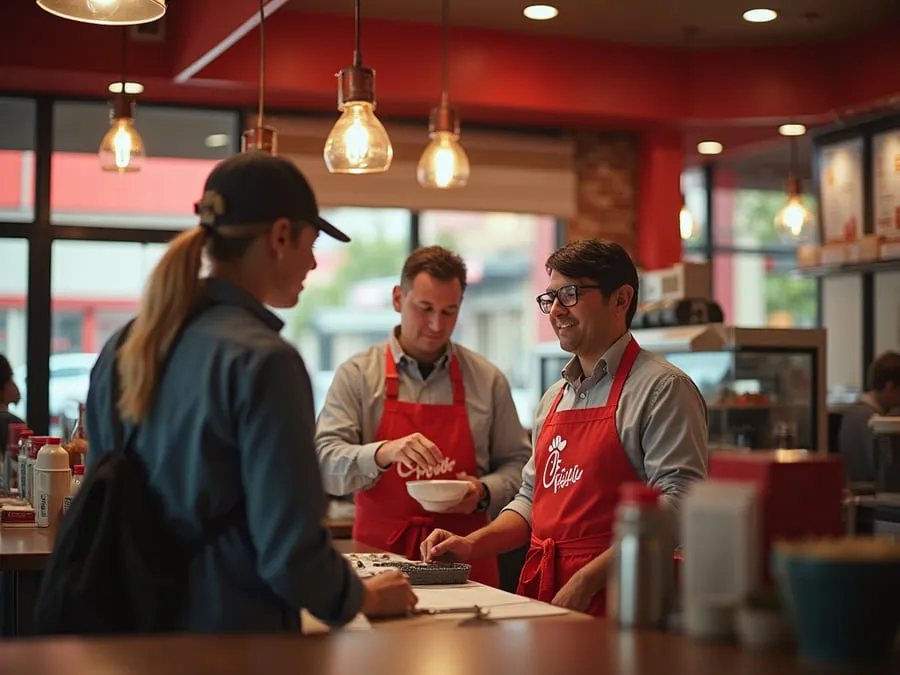
The operator model only functions if the operators selected are the right people. Chick-fil-A’s selection process is famously rigorous, with acceptance rates reportedly below 1%.
→ Read more: Franchise vs. Independent Restaurant The company is not selecting investors — it is selecting operators who will run a restaurant that the company owns, in a culture the company defines.
According to History Tools’ analysis, this selectivity produces a hospitality culture that is distinctive enough to function as a genuine competitive advantage. The “my pleasure” service philosophy — employees responding to customer thanks with a specific phrase that signals genuine engagement rather than rote politeness — is not accidental. It is trained and selected for, consistently, across thousands of locations.
This cultural consistency at scale is not achieved through financial alignment alone. Traditional franchises align incentives through ownership: the franchisee benefits financially when the restaurant performs and suffers when it does not. Chick-fil-A achieves the same alignment through a different mechanism — selecting operators who genuinely share the company’s values and culture, then entrusting the restaurant’s success to their care.
The Common Thread: Disciplined Refusal
In-N-Out, Raising Cane’s, and Chick-fil-A do not share a business model — they are structured very differently. What they share is a disciplined refusal to do things that conventional wisdom recommends but that would compromise the specific thing that makes each of them work.
In-N-Out refuses to expand faster than its fresh supply chain can support, even though this limits geographic reach. Raising Cane’s refuses to add menu items, even though additional items might drive incremental revenue. Chick-fil-A refuses to franchise in the conventional sense and refuses to be open on Sundays, even though both decisions reduce total revenue.
Each refusal preserves something that the alternative would destroy: In-N-Out’s freshness guarantee, Raising Cane’s operational simplicity, Chick-fil-A’s cultural consistency. The operators who understand why these refusals matter — what problem each one is solving — are the operators who can apply the principle to their own concept.
The question is not whether to copy In-N-Out’s menu or Raising Cane’s structure. The question is: what is the thing your concept does that is worth protecting at the cost of opportunities you are choosing not to pursue?
→ Read more: McDonald’s Franchise and Real Estate Model
→ Read more: Restaurant Compensation and Tipping Structures The fast-food innovators who have built the most durable brands all have a clear answer to that question, and they defend it consistently.