· Suppliers · 12 min read
Restaurant Equipment and Technology Procurement: A Buyer's Guide to Smart Capital Spending
Equipment and technology represent your largest capital expenditures after real estate. Learn how to plan purchases from the menu outward, evaluate new versus used, finance smartly, and select technology vendors that deliver ROI instead of headaches.
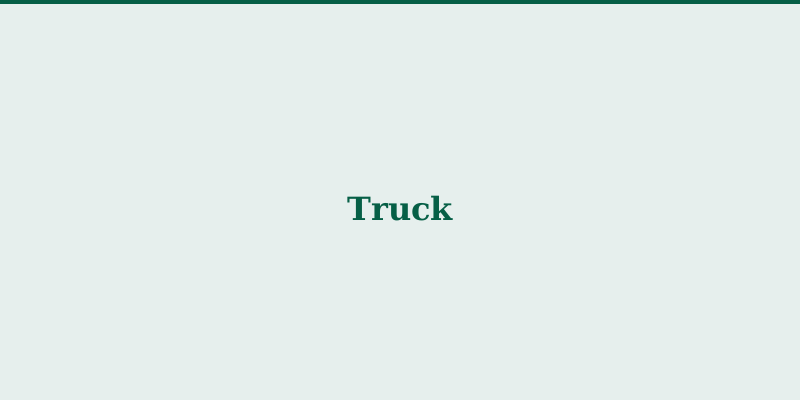
Equipment and technology are not one-time purchases. They are multi-year commitments that shape your kitchen’s workflow, your team’s efficiency, and your operating costs for a decade or more. A commercial oven lasts 10 to 15 years. A POS system touches every transaction. A walk-in cooler runs 24 hours a day, 365 days a year.
The decisions you make in procurement, what to buy, whether to buy new or used, how to finance it, and which technology vendors to partner with, compound over time. This guide covers the frameworks, benchmarks, and supplier strategies that help you spend wisely and avoid the traps that catch unprepared operators.
Plan Equipment Purchases From the Menu Outward
According to Lightspeed, the cardinal rule of equipment procurement is to plan the menu before buying commercial kitchen equipment, then purchase only what the menu requires. A pasta-focused restaurant needs mixers, dough sheeters, and pasta machines. A burger concept needs heavy-duty grills and fryers. Over-equipping is a common and expensive mistake.
Before you buy anything, answer these questions:
- What does my menu require? Conduct a menu analysis to identify every piece of equipment needed for every dish.
- What is my kitchen layout? Measure the space, identify zones (cold prep, hot line, plating, wash), and confirm that selected equipment fits the workflow.
- What is my expected volume? A 40-seat casual restaurant has very different capacity needs than a 150-seat high-volume operation.
- What is my realistic budget? According to WebstaurantStore, a $200,000 kitchen with all new equipment can be built for approximately $150,000 using a mixed approach of new, used, and leased equipment.
Essential Equipment Categories
According to Lightspeed, major equipment falls into these categories:
| Category | Key Items | Expected Lifespan |
|---|---|---|
| Cooking | Commercial ovens, ranges, grills, griddles, fryers | 10-15 years |
| Refrigeration | Walk-in coolers, reach-in refrigerators, freezers | 10-20 years |
| Preparation | Food processors, mixers, slicers, prep counters | 5-15 years |
| Sanitation | Multi-compartment sinks, hand-washing stations, commercial dishwashers | 7-12 years |
| Ventilation | Hood systems, fire suppression, exhaust fans | 15-20 years |
| Small appliances | Blenders, food warmers, toasters | 5-10 years |
| Technology | POS systems, kitchen display systems, digital signage | 3-7 years |
Equipment Worth the Investment
According to experienced operators at Fallow restaurant, the combination oven (combi oven) is the most versatile single piece of kitchen equipment. At approximately $12,000 to $13,000 total including the ultra-vent hood, it is a major expense. But a combi oven replaces multiple pieces of equipment by offering roasting, steaming, and combination modes with precision temperature and humidity control. For any restaurant serving hot food beyond simple grill items, the combi oven is essentially non-negotiable.
At the other end of the spectrum, gastronorm pans (GN pans) at $4 to $6 each are the universal currency of professional kitchens. According to Fallow, a typical professional kitchen has 300 to 400 in rotation. They organize your refrigeration, prep tables, and serving lines. Starting with enough GN pans in various sizes prevents workflow bottlenecks during service.
The Total Cost of Ownership Mindset
According to Lightspeed, compare total cost of ownership including maintenance, energy consumption, and expected lifespan rather than focusing solely on purchase price. According to experienced operators at Fallow, equipment breaks regardless of price point. Factor ongoing maintenance and repair costs into every purchasing decision.
A practical example: a standard commercial fryer at approximately $2,000 that lasts five years with minimal maintenance may be a better investment than a premium turbo self-filtration fryer at approximately $4,200 with the same lifespan and expensive proprietary parts. The premium features only justify the cost if your volume and quality requirements demand them.
New Versus Used Equipment
According to Lightspeed, new equipment provides warranties, broader selection, and known condition at higher upfront cost. Used equipment offers significant savings but carries risks of unforeseen damage and typically comes without warranty protection.
When to Buy New
- High-use, critical items where downtime halts operations (primary oven, main refrigeration)
- Safety-critical equipment like ventilation and fire suppression systems
- Technology that needs to integrate with your current systems and receive software updates
- Items where energy efficiency matters because new models consume significantly less power
When to Buy Used
- Supplementary equipment that is not mission-critical (secondary prep tables, extra shelving)
- Items with long lifespans where a five-year-old unit still has a decade of use remaining
- Startup operations where capital conservation is critical
According to experienced operators featured on Coffee Business Basics, used equipment from auctions saves 50 to 70 percent and provides adequate functionality for startup operations. The pragmatic approach, as recommended by Lightspeed, buys critical high-use items new while considering quality used options for supplementary equipment.
Where to Find Used Equipment
- Restaurant auction houses (when restaurants close, equipment goes to auction)
- Liquidation sales from closures or renovations
- Reputable secondhand equipment dealers (ask for references)
- Online marketplaces for restaurant equipment
Always inspect used equipment in person before purchasing. Run it through a full operational cycle. Check for unusual noises, leaks, temperature accuracy, and structural wear. Ask for maintenance records if available.
Where to Buy Equipment
Local Restaurant Supply Stores
According to Lightspeed, local stores offer personalized guidance and the ability to see and test equipment in person. They are your best option when you need expert advice on choosing between models, sizing equipment for your space, or troubleshooting a specific layout challenge.
Online Retailers
According to RestaurantSupply.com and Lightspeed, online retailers like WebstaurantStore and RestaurantSupply.com provide convenience and competitive pricing for operators who know exactly what they need. Other notable online suppliers include Wasserstrom, KaTom Restaurant Supply, GoFoodservice, and CKitchen.
Online purchasing works best when you have already determined the exact make and model you need, verified that the specifications match your space and electrical requirements, and confirmed that return policies and shipping logistics are acceptable.
Smallwares: A Special Category
According to RestaurantSupply.com, smallwares encompass the tools and utensils used for food preparation, cooking, serving, and storage. While individually inexpensive, they represent a significant cumulative investment and their quality directly affects kitchen efficiency.
Smart smallwares purchasing strategy, according to RestaurantSupply.com:
- Build relationships with one or two primary suppliers for consistent pricing
- Maintain a par stock system to trigger reorders before running out
- Budget for replacement as a regular operating expense, not a one-time cost
- Invest in quality for high-use items like knives and cookware
- Accept standard quality for lower-impact items like storage containers
For items that contact food, NSF certification ensures safety and sanitation compliance. Commercial-grade items are designed for the demands of restaurant use and will outlast consumer-grade alternatives.
→ Read more: Online Equipment Supplier Comparison
→ Read more: Smallwares and Utensils Procurement
Financing Your Equipment
You do not have to pay for everything upfront. Several financing strategies can preserve your cash flow while equipping your kitchen.
Buying: Build Equity
Purchasing equipment outright costs more upfront but builds equity. You own the asset, which can serve as collateral for future loans, be depreciated for tax purposes, and be sold if your needs change. According to WebstaurantStore, purchased equipment allows depreciation deductions and potential benefits for energy-efficient models.
Leasing: Preserve Cash
According to WebstaurantStore, leasing preserves capital by eliminating large upfront costs. Fixed monthly payments make budgeting predictable, and many lease agreements cover repairs and upkeep. Lease payments are typically tax-deductible as business expenses.
The drawbacks are real: you never build equity, accumulated lease payments often exceed purchase prices over time, and leases may restrict modifications and impose early termination penalties. According to WebstaurantStore, new restaurants should consider leasing while established operations benefit more from purchasing.
Equipment Financing Loans
According to Crestmont Capital, restaurant equipment financing allows you to borrow up to 100 percent of the equipment cost, with the equipment itself serving as collateral. Terms typically run 3 to 10 years depending on the expected lifespan of the equipment.
SBA Loans
According to Crestmont Capital, SBA loans represent one of the most favorable financing options:
| SBA Program | Best For | Maximum Amount | Term Length |
|---|---|---|---|
| SBA 7(a) | General purpose (working capital, equipment, inventory) | $500,000 | Up to 10 years for equipment |
| SBA 504 | Major fixed assets (real estate, heavy equipment) | $5.5 million | 10, 20, or 25 years |
Down payments can be as low as 10 percent. Most SBA lenders require a personal credit score of at least 620. Restaurants are the most popular business category for SBA loans, so lenders are familiar with the industry.
The Hybrid Approach
According to WebstaurantStore, the optimal strategy for most restaurants combines buying, leasing, and used equipment:
- Buy new: Primary cooking equipment, refrigeration, ventilation
- Buy used: Prep tables, shelving, supplementary storage, secondary equipment
- Lease: High-cost technology that requires regular upgrades (POS hardware, kitchen display systems)
This mixed approach can reduce a $200,000 kitchen buildout to approximately $150,000.
Technology Vendor Selection
Selecting technology vendors requires a different evaluation framework than choosing equipment suppliers. With technology, the ongoing relationship matters more than the initial purchase.
Start With Your Operational Needs
According to OrderEM, before selecting a vendor, assess your specific operational requirements. Determine whether the priority is inventory tracking, customer management, POS systems, or other tools. Choosing technology without clarity about actual needs leads to expensive software that fails to solve real problems.
According to OrderEM, 62 percent of organizations prefer custom technology over off-the-shelf software because generic solutions lack the flexibility to address unique operational challenges.
The Modern Restaurant Technology Stack
According to NovaTab, a complete restaurant technology stack includes:
- Point-of-sale (POS) system — the central hub for transactions, reporting, and operations
- Kitchen display system (KDS) — replaces paper tickets with digital order management
- Online reservation system — manages guest bookings and table assignments
- Self-order kiosks — for fast-casual and QSR concepts
- Payroll and scheduling — staff management and labor compliance
- Inventory management — stock tracking, ordering, and waste reduction
Integration Is Non-Negotiable
According to OrderEM, 69 percent of restaurants use multiple technology systems that need to communicate with each other. According to NovaTab, vendors that resist integration with other systems create operational silos that undermine the value of the entire technology investment.
Before committing to any vendor, verify that their system integrates with:
- Your existing POS or the POS you plan to adopt
- Your accounting software
- Your inventory management platform
- Third-party delivery platforms (if applicable)
- Your payroll and scheduling system
Fragmented systems that cannot share data create manual workarounds, duplicate data entry, and blind spots in your reporting.
Reliability and Offline Capability
According to NovaTab, most restaurants cannot function when their POS system goes down. If your internet connection is unreliable, cloud-based POS systems must offer an offline mode that maintains operations during outages. Ask every technology vendor: what happens when the internet goes down? If the answer involves your operation grinding to a halt, that is a disqualifying response.
Security and Compliance
According to NovaTab, technology must comply with PCI DSS (Payment Card Industry Data Security Standard) for payment processing and relevant data privacy regulations. Check the vendor’s data breach history. Require advanced security protocols and regular software updates as baseline requirements, not premium add-ons.
Training and Support Over Features
According to OrderEM, the toughest part of implementing restaurant technology is not choosing the software but getting the team to use it consistently. Choose vendors providing comprehensive staff training and continuous technical support. A system with 50 features that your team actually uses beats a system with 200 features that sits idle.
Run a Pilot Test
According to NovaTab, before committing to any technology vendor, run pilot tests that involve both front-of-house and back-of-house staff. This ensures the technology works in your actual operational context, not just in a demo environment. A one to two week pilot reveals usability issues, integration problems, and training gaps that you cannot identify from a sales presentation.
Evaluating Any Equipment or Technology Vendor
Whether you are buying a combi oven or selecting a POS provider, according to Restroworks, the evaluation framework is consistent.
Due Diligence Checklist
- Operational needs clearly defined before vendor conversations begin
- Industry-specific experience confirmed (restaurant operations, not generic business)
- References checked with operators running similar concepts
- Product samples tested or pilot programs completed
- Pricing compared across at least three vendors
- Total cost of ownership calculated (not just purchase price)
- Integration capabilities verified with existing systems
- Warranty, maintenance, and after-sales support terms documented
- NSF or equivalent certifications confirmed for equipment
- Security and compliance standards verified for technology
- Contract terms reviewed including termination clauses
- Training and onboarding plan confirmed
Red Flags
According to Restroworks, watch for these warning signs:
- No references or certifications — legitimate vendors have both
- Inconsistent delivery records — problems with delivery during evaluation will only get worse
- Non-transparent pricing — hidden fees, vague quotes, or resistance to detailed line-item breakdowns
- No after-sales support plan — post-purchase support is as important as the initial sale
- Resistance to pilot testing — confident vendors welcome trials
→ Read more: Equipment Financing and Procurement
→ Read more: Restaurant Technology Landscape
Maintenance: Protecting Your Investment
According to Lightspeed, regular preventive maintenance extends equipment lifespans significantly. Establish maintenance schedules from day one, not after the first breakdown.
Maintenance Planning
| Equipment | Maintenance Frequency | Key Tasks |
|---|---|---|
| Refrigeration | Monthly | Clean condenser coils, check gaskets, verify temperatures |
| Cooking equipment | Weekly | Clean burners, calibrate thermostats, inspect gas connections |
| Dishwashers | Daily/Weekly | Clean filters, check wash/rinse temperatures, inspect spray arms |
| Ventilation | Monthly/Quarterly | Clean filters, inspect ductwork, verify airflow rates |
| POS/Technology | Monthly | Software updates, hardware cleaning, data backup verification |
Build Maintenance Into Your Budget
According to Lightspeed, budget for equipment replacement as a regular operating expense. Establish a capital expenditure reserve of 1 to 3 percent of revenue annually for equipment maintenance and replacement. This prevents the financial shock of an unexpected failure forcing an emergency purchase at the worst possible time.
Key Takeaways
- Start from the menu. Every equipment purchase should trace to a specific operational need driven by your concept and menu.
- Calculate total cost of ownership. Purchase price is the beginning, not the end. Maintenance, energy, and expected lifespan determine the true cost.
- Use a hybrid acquisition strategy. Buy critical items new, consider used for supplementary equipment, and lease technology that needs regular upgrades.
- Evaluate technology vendors on adoption, not features. Integration capability, training support, and offline reliability matter more than the feature list.
- Pilot test before committing. Both equipment and technology should prove themselves in your actual operating environment.
- Maintain from day one. Preventive maintenance extends equipment life and prevents expensive emergency replacements.
The equipment and technology you choose will serve you for years. Invest the time to choose well, and they will pay you back every day they operate.