· Operations · 10 min read
Health Inspection Preparation: What Inspectors Look For and How to Score High
Health inspections are unannounced and consequential — the only reliable strategy is daily compliance, not periodic preparation.

The single most important thing to understand about health inspections is this: they are unannounced. You cannot schedule your compliance. The inspector who arrives on a Tuesday at 2:30 PM in the middle of your prep shift is evaluating what your operation actually looks like on an ordinary day, not the polished version you would present if you had advance notice. Your cleaning and sanitation schedule is the daily system that makes this distinction irrelevant.
7shifts’ inspection guide notes that inspections typically occur one to three times per year depending on jurisdiction. That sounds infrequent enough to manage reactively. But if your operation spends 362 days of the year operating below standards and scrambles three times a year when an inspector might be coming, you are not running a food-safe operation — you are running an operation that is statistically likely to cause a foodborne illness and eventually fail an inspection when it matters most.
The right mental model is continuous compliance. Every operational decision every day should meet inspection standards, because the inspection is a snapshot of your actual daily operation.
How the Inspection Unfolds
According to WebstaurantStore’s health inspection guide, inspections follow a predictable structure even though their timing is not predictable. Understanding the process helps you manage it effectively.
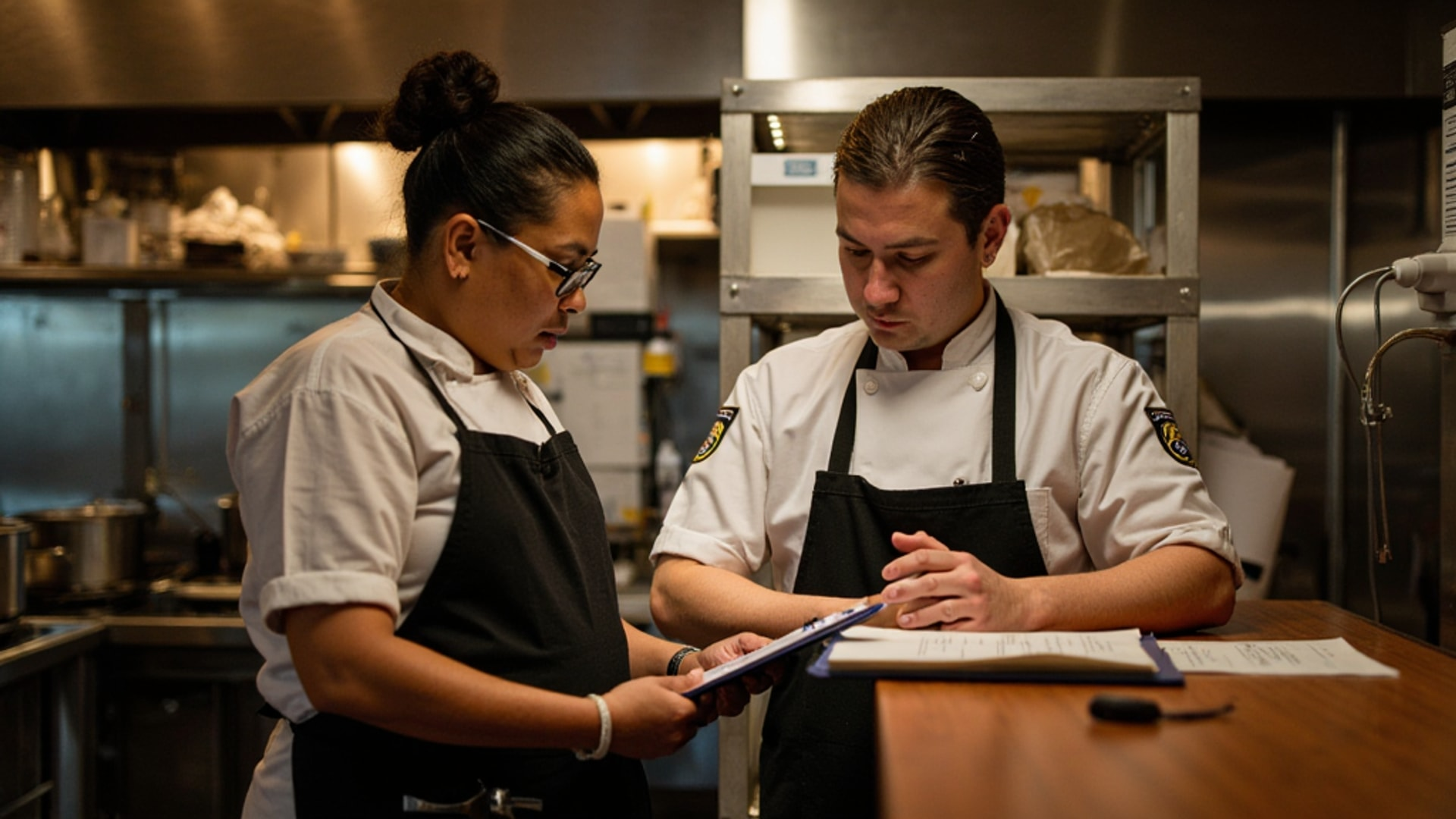
The inspector arrives, presents credentials, and announces the inspection. Your appropriate response is to verify credentials, welcome the inspector, and assign a manager to accompany them throughout the facility. Do not assign a line cook or server — the accompanying manager should understand your systems, be able to answer questions about procedures, and be capable of taking notes on any findings.
The inspection then surveys the restaurant and kitchen systematically. Most inspectors follow the flow of food through the facility: receiving, storage, preparation, cooking, cooling, holding, and serving. This is also the path recommended by Johnson & Wales University’s inspection guide for your own self-inspections — it mirrors the inspector’s logic and helps you find issues proactively.
After completing the inspection, the inspector issues findings, documents violations, and assigns a score or grade. Severe violations may trigger required immediate corrective action or a follow-up re-inspection. Sign the report — WebstaurantStore emphasizes that signing is acknowledgment, not agreement with every finding.
Scoring Systems: What the Numbers Mean
Scoring systems vary by jurisdiction, but WebstaurantStore’s guide provides benchmarks for the common 100-point scale: 90 and above is considered good condition, 80-89 is adequate, 70-79 needs improvement, and 69 or below is poor. Letter-grade systems, used in cities like Los Angeles and New York, assign A grades for few or zero violations, B grades for multiple violations across categories, and C grades for many violations across both risk levels.
Crucially, not all violations are weighted equally. The National Restaurant Association’s guide distinguishes between violation types — those involving direct food safety hazards (temperature violations, cross-contamination risks, improper handwashing) carry greater consequences than infrastructure or housekeeping issues. Similarly, Lightspeed’s preparation guide distinguishes between minor infractions — missing hair nets, cracked floor tiles, inadequate ventilation — and major violations like broken refrigeration equipment, missing handwashing stations, and improper sanitization of food-contact surfaces.
Your preparation priority should mirror this weighting. Eliminate major violation risks first. The minor items matter, but a low refrigeration temperature is a public health hazard; a cracked tile is a maintenance issue.
Temperature Control: The Highest-Stakes Area
Temperature violations are among the most common and most heavily penalized inspection findings. The regulatory frameworks are specific and non-negotiable.
According to the National Restaurant Association’s guide, the temperature danger zone where bacterial growth accelerates spans 41 to 135 degrees Fahrenheit. Cold foods must stay at or below 41 degrees; hot foods must be maintained at 135 degrees or above. Refrigerators should run at or below 40 degrees Fahrenheit (4 degrees Celsius), and freezers at 0 degrees Fahrenheit (minus 17 degrees Celsius), per Lightspeed’s guide.
The NRA emphasizes that inspectors expect to see written or electronic records documenting when temperatures were taken and by whom. A refrigerator that happens to be at 38 degrees when the inspector checks it is far less credible evidence of compliance than a temperature log showing consistent readings throughout the day and across multiple shifts.
Implement scheduled temperature checks with documentation: every walk-in and reach-in at opening, midday, and closing minimum. Log the results with staff initials and timestamps. This log is among the first items inspectors request and among the most powerful demonstrations of a well-managed operation.
Food Storage: The Vertical Sequence That Inspectors Check
Improper food storage is one of the most common violations — and one of the most preventable. The rules are clear and consistent across regulatory frameworks.
The NRA guide specifies the correct top-to-bottom sequence in vertical storage: ready-to-eat food at the top, then seafood, then whole cuts of beef and pork, then ground meat and fish, then poultry at the bottom. This sequence prevents drip contamination from raw proteins reaching ready-to-eat foods. An inspector who opens your walk-in and finds raw chicken stored above cooked vegetables has found a critical violation immediately.
Both the 7shifts and WebstaurantStore guides confirm that all food must be stored at least six inches off the ground, even in walk-in coolers. Items on the floor fail inspection regardless of what they are. Six inches of clearance is non-negotiable.
All stored items require proper labeling with expiration dates. FIFO (first in, first out) rotation — using older inventory before newer — is both a best practice and an inspection standard. Inspectors will check date labels. Unlabeled items or obviously expired products are immediate findings.
Cross-Contamination: Beyond Storage
Cross-contamination risk extends beyond storage arrangements to preparation practices, utensil management, and allergen handling. The NRA guide recommends color-coded cutting boards and utensils to prevent cross-contact between raw proteins, produce, and cooked foods. This system needs to be actually used consistently, not just displayed.
Lightspeed’s guide highlights the scale of food allergies as a safety concern: approximately 33 million Americans and over 2.4 million people in the UK have at least one diagnosed food allergy. Allergen management — designated preparation surfaces, thorough cleaning between allergen-containing preparations, staff knowledge of menu ingredients — is an increasingly scrutinized inspection area.
Employee Hygiene and Illness Policy
Staff are both the most critical food safety control and the most variable one. The NRA guide details when handwashing is required: after using restrooms, handling raw foods, touching the face, eating, clearing tables, and handling chemicals. These are not suggestions — they are inspection criteria.
Lightspeed’s guide provides the most striking statistic in this area: sick workers are responsible for up to 40% of restaurant food poisoning outbreaks. An explicit, enforced policy requiring ill employees to stay home is not just a health management practice — it is a significant food safety control. Document the policy, train every new hire on it, and enforce it consistently.
Staff hygiene requirements include clean daily clothing, appropriate aprons and gloves, hair coverings for kitchen staff, and removal of jewelry in food preparation areas. These are visible, observable standards that inspectors assess quickly on walk-through.
The HACCP Plan: Your Documented Safety System
HACCP — Hazard Analysis and Critical Control Points — is the foundational framework for systematic food safety management. As Johnson & Wales University’s inspection guide explains, HACCP identifies the specific points in each food preparation process where contamination risk is greatest, establishes monitoring procedures and critical limits at each point, and defines corrective actions when limits are exceeded.
WebstaurantStore recommends maintaining a current HACCP plan as a core pre-inspection preparation step. 7shifts notes that the FDA recommends HACCP plans for all food service operations. Having a documented HACCP plan signals to an inspector that your operation has systematically thought through its food safety risks — not just reactively cleaned ahead of an inspection.
Your HACCP plan should document: the flow of each menu item from receiving through service, identified critical control points (temperatures, times, cross-contamination risks), monitoring procedures at each control point, corrective action procedures when limits are exceeded, and verification procedures confirming the system is working.
Self-Inspection: The Most Effective Preparation
The most reliable path to consistently high inspection scores is conducting your own inspections using the actual criteria your jurisdiction uses.
WebstaurantStore recommends six preparation steps: review your HACCP plan regularly, study common violations in your area, consult your local health department for specific regulations, conduct random unannounced self-inspections, quiz employees regularly on food safety protocols, and maintain continuous monitoring between formal inspections.
The self-inspection walk-through should follow the same path an inspector uses: start at the exterior entrance and progress through the food flow — receiving dock, storage areas, prep stations, cooking line, holding areas, and service. This systematic approach reveals issues in their actual operational context rather than in isolation.
Johnson & Wales recommends quizzing staff on safety practices related to their current tasks during self-inspections. An inspector may ask a prep cook how they would handle a thawing situation or what temperatures they use for cooling cooked proteins. The answer reflects whether training is theoretical knowledge or operational practice.
Lightspeed recommends monthly or quarterly self-audits using comprehensive checklists. At minimum, managers should conduct an informal walk-through against inspection criteria before every service — not a formal audit, but a trained eye looking for common violation risks that can be corrected in the moment.
Documentation as Evidence
Documentation is the often-overlooked element that separates operations that simply comply from operations that can prove they comply. The NRA emphasizes that temperature logs, training records, and cleaning schedules serve as evidence of ongoing compliance and are among the first items inspectors request.
Maintain and make readily accessible: temperature logs (refrigeration and hot-holding), cleaning and sanitization schedules with completion records, food handler certification documentation for all staff, pest control service records, and any corrective actions taken in response to previous violations or self-inspection findings.
When an inspector asks “how do you know your walk-in has been holding temperature?” the answer should be “here is our log from the past 30 days,” not “we check it every day.” Documentation converts a verbal assertion into verifiable evidence.
What to Do When Violations Are Found
Follow the inspector throughout the visit. Take your own notes on every finding — these will be more detailed than the official report and more useful for internal corrective action. Sign the report when complete, understanding that this is acknowledgment of receipt, not agreement with every finding.
For violations that can be corrected on the spot during the inspection, do so. Correcting something immediately demonstrates operational responsiveness and may affect how the inspector documents the finding.
For violations requiring process changes, equipment repair, or staff training, develop a specific corrective action plan with timelines and assigned accountability. Contact your local health department if you have questions about compliance standards or need clarification on what specific corrective action is required.
Most importantly, use every inspection finding — from formal inspections and from your own self-audits — as a training moment. The violation is evidence that a standard is not embedded in daily practice. Embed it.
→ Read more: Restaurant Cleaning and Sanitation Schedules: Daily, Weekly, and Monthly Checklists → Read more: Food Safety and CDC Foodborne Illness Prevention: What Every Restaurant Must Know → Read more: Food Safety and HACCP: The System That Protects Your Guests and Your Business